Utopia music
Making music discovery feel less like a negotiation and more like finding the right match.
Utopia Music ✸ 2022
Product Designer
AI · Music Discovery · B2B · Data Complexity
Utopia Music was a fast-scaling music fintech building infrastructure for global rights management and royalty distribution, working with major labels to make the music industry more transparent, connected and accessible.
Within this ecosystem, one opportunity focused on helping content creators and music professionals find the right music for their projects and navigate the complex process that follows.
Music discovery was only one part of the experience. Finding the right track often involved multiple people, subjective creative decisions and conversations around rights and licensing.
Music is emotional. The process of finding it isn't.
6 months ✸ partnered with Product, Engineer, Data and Marketing

/// Problem
Finding the right track was only part of the challenge
Content creators and music professionals were navigating a fragmented process.
The journey could begin with a creative idea, a feeling or a reference — but translating that into the right track was often subjective and time-consuming. And even when the right music was found, the journey didn't necessarily end there.
1 — Music discovery is highly subjective
Users were not always searching for a specific artist or track. They were often trying to translate a mood, story or creative intention into music.
2 — The journey was fragmented
Finding a track was only one part of a wider process involving selection, collaboration, negotiation and rights clearance.
3 — The right track has to work on multiple levels
A track can be creatively right but commercially or practically unsuitable. Users need to balance creative fit with metadata, licensing, availability and other requirements.
From zero to MVP: shaping an AI-powered music discovery product from research to reality.
—
discovery  AI / ML Delivery
✷ Defined the MVP direction — worked closely with the Product Director and Engineering Manager to translate the product vision into a focused feature set, prioritising music discovery based on user value and technical feasibility.
✷ Shaped the AI / recommendation experience — worked with Engineers and Data Scientists to connect creative briefs, music metadata and licensing parameters, helping users find relevant tracks across large catalogues.
✷ Bridged user needs and technology — translated research insights into product concepts, prototypes and interaction flows, creating a direction the team could validate and move towards implementation.
/// Discovery → Product Direction
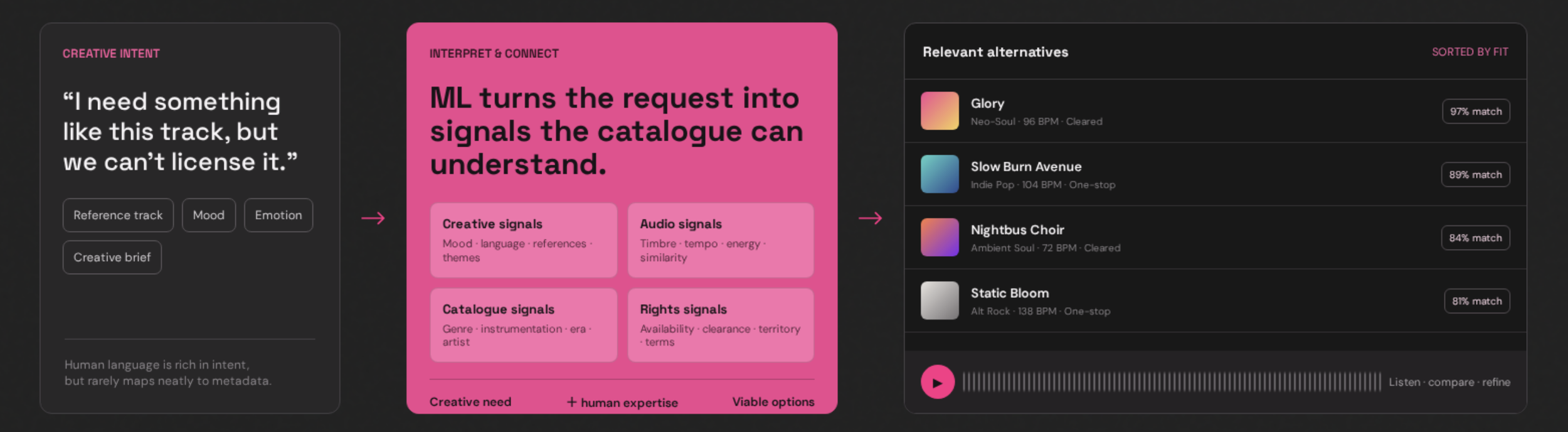
Bridging how people describe music with how catalogues are structured
Creative teams search through briefs, references, moods and emotions. Catalogues organise music through metadata, audio characteristics and licensing constraints.
The opportunity wasn't simply “AI search”. It was to make creative intent searchable — helping experts discover relevant music while keeping them in control.
Sync is both creative and strategic
Finding the right track goes beyond creative fit. It means balancing creative intent, context, rights and commercial needs, while relying on music expertise and relationships to navigate decisions.
We also learned that discovery starts with language: people rarely know exactly what track they need, instead describing a feeling, scene, sound or reference. This shaped our direction towards bridging creative intent with a large, structured music catalogue, making discovery the natural focus for the MVP.
/// Opportunity
From searching a catalogue to finding the right match
Working closely with the Product Director and Engineering Manager, we defined how AI and recommendation capabilities could translate into a focused discovery experience for the MVP.
The broader product vision included discovery, collaboration and music rights. We decided to start with the part of the journey where we could create the most immediate value: music discovery.
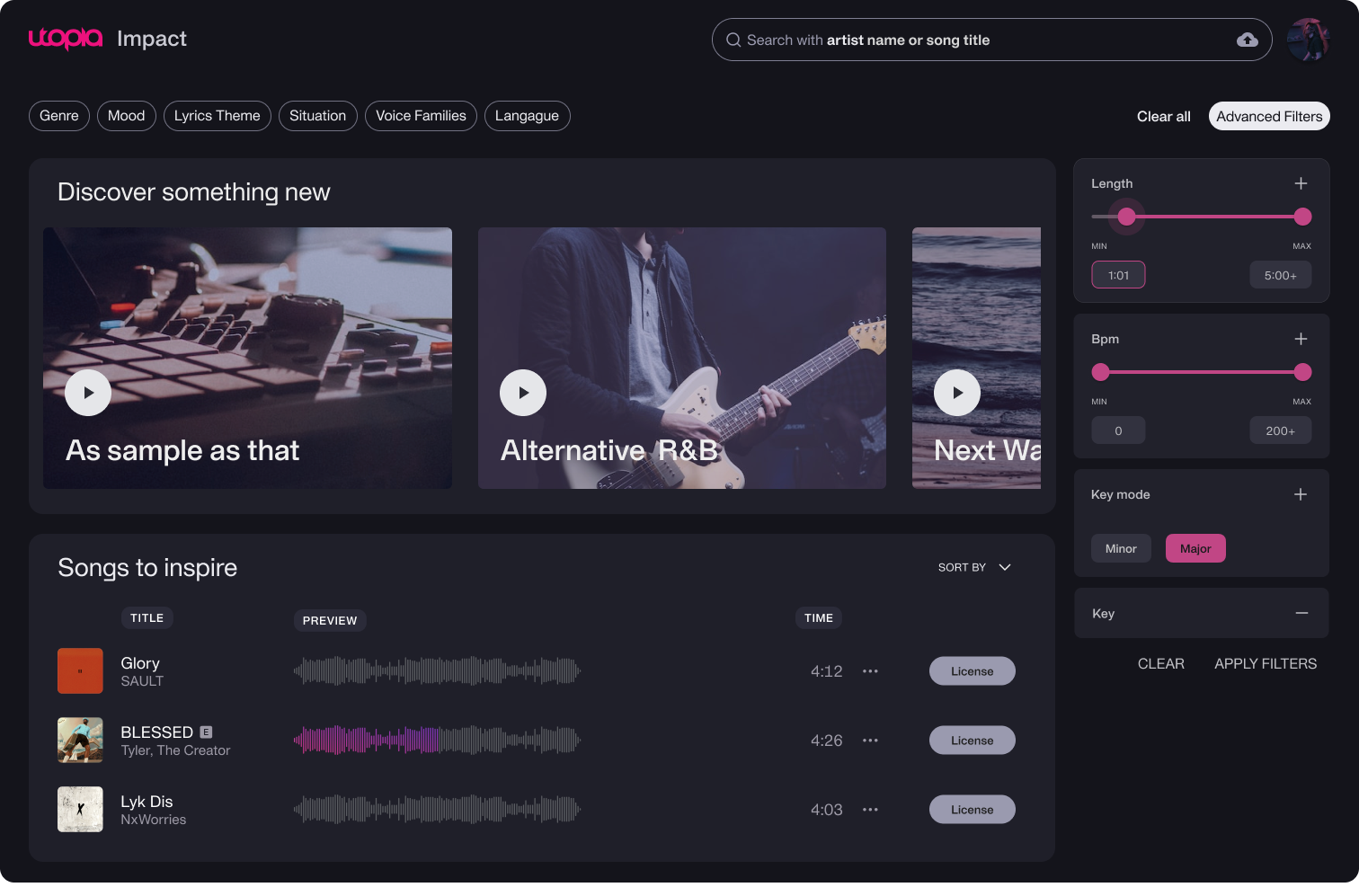
The MVP focused on three core capabilities:
SEARCH
Find music across a large catalogue using technical and contextual attributes — from genre, mood and instrumentation to BPM, vocals and length.
RECOMMEND
Surface relevant tracks based on the user's search intent and catalogue signals.
PLAY
Preview and compare tracks directly within the discovery experience.
/// Reflection
Designing beyond what the interface could solve
✷ The interface was the visible part of the problem → the harder challenge was understanding the ecosystem around the interface.
✷ Search isn't always about knowing what you're looking for → in creative workflows, people often search through feelings, references and language before they can articulate an exact requirement.
The goal wasn't to automate the music expert out of the process. It was to give them better tools to make their expertise more effective.
Rather than solving discovery, negotiation and licensing simultaneously, we focused the first experience on the highest-value friction: finding the right music quickly.